Edmond Davern
The baptism reads “Edm.”, with parents Jeremiah Davern and Mary Anne Raleigh. It gives us another record of the couple, but does not name Jeremiah’s parents.
HOSPITAL, CO. LIMERICK · IRELAND
Following the Daverns through the records they left behind. A family tree, a growing collection of evidence, and a question that leads towards the Burren.
Explore the family tree ↓Built from original records. Open about what we don’t yet know.
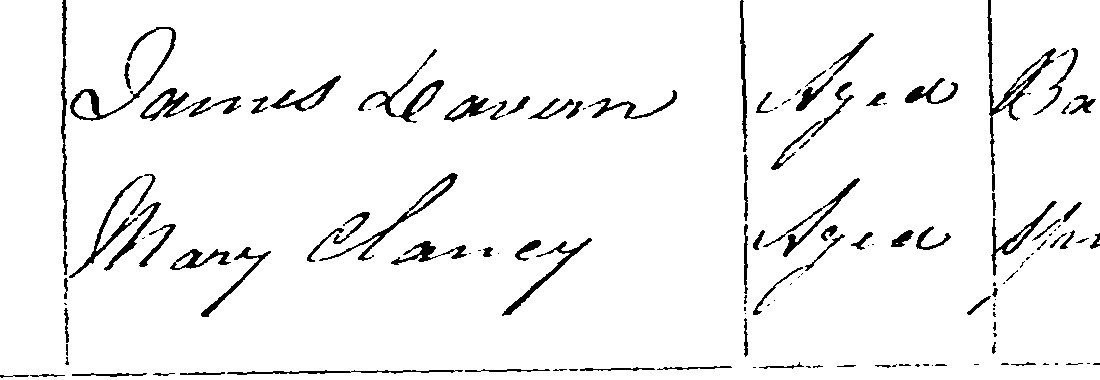
James Davern
& Mary Clancy
THE FAMILY TREE
Select a person to see their story and the records behind it. This public tree contains historical relatives only.
No matching names. Try “James”, “Clancy” or “Lizzie”.
A RECORD THAT MOVED US FORWARD
The 1870 marriage of James Davern and Mary Clancy names James’s father as Jeremiah Davern, a chandler. It is the first original record in this archive supporting that father–son relationship.
A newly examined parish entry records Jeremiah Davern marrying Mary Anne Raleigh on 23 February 1843 in Hospital. This is a strong candidate for the same man, but James’s baptism is still needed to establish his mother.
A CANDIDATE BRANCH · NEW ORIGINAL EVIDENCE
The 1844 baptism records a child of the couple who married in 1843. Their connection to James remains under investigation.
The baptism reads “Edm.”, with parents Jeremiah Davern and Mary Anne Raleigh. It gives us another record of the couple, but does not name Jeremiah’s parents.
Two civil marriages were checked: Edmond Daveran and Eliza Condon (1868), and Edmond Davern and Johanna Connors (1882). Their fathers are recorded as Denis and John respectively. Neither is a secure match for the 1844 child of Jeremiah.
No wife or children have yet been securely identified for him. He is also distinct from James and Mary Clancy’s son Edmond, born around 1874–1875.
1868 marriage ↗ 1882 marriage ↗02 / THE EVIDENCE
Open a source, read our transcription, and check the original. A record can establish a relationship without resolving every detail.
Documented facts, likely identifications and family recollections are labelled separately. Similar surnames alone do not establish kinship. This is a research archive, not a completed pedigree.
03 / AN OPEN QUESTION
CONNECTION NOT YET ESTABLISHEDFamily tradition points towards the O’Davorens of Clare. We are looking for the records that could connect the two stories.
The O’Davorens’ law school at Cahermacnaughten belongs to the history of the Burren. Clare Libraries preserves a historical account and pedigrees. Our Hospital family has not yet been linked to a named person in them.
Explore the Clare sources ↗A family recollection says Jeremiah may have gone to Boston. No matching passenger, naturalisation or Massachusetts vital record has been established for James’s father.
Massachusetts research sources ↗Rita Davern’s Burren Girl follows her grandmother Anne Davoren’s Clare roots. It offers context and research leads, but does not establish a relationship to this Hospital branch.
Discover Burren Girl ↗THE DISTANCE BETWEEN THE STORIES
What might travel between Hospital and the Burren have involved in the 1600s or 1700s? Explore a possible overland corridor and change the assumptions below.
01 / CHOOSE A PERIOD
Walking, riding or using pack animals were possible choices. A cart needed a passable road; weather and conflict could disrupt travel.
02 / HOW WOULD YOU TRAVEL?
An illustrative distance range, allowing for road bends and detours. We have not measured or reconstructed a complete historic route.
At 20–30 km per day, with overnight stops. Family baggage, illness, winter weather or delays could make the journey longer.
Map loading. Open the region in OpenStreetMap ↗
The dashed line joins reference places; it is not a surveyed road or a recorded family journey. The basemap shows today’s geography and roads.
Thomond Bridge provided a crossing long before the present bridge opened in 1840. That makes Limerick a plausible reference point for an overland journey between the two areas. It does not establish which crossing a family used.
National Inventory of Architectural Heritage ↗Taylor and Skinner’s road maps include Sixmilebridge–Ennis and Ennis–Kilfenora. These are useful period sources for testing a corridor. They do not prove the same roads were usable in the 1600s.
Clare Libraries: road maps, 1783 ↗Cahermacnaghten marks the O’Davoren law-school site, not a proven ancestral home for our Hospital branch. We have no document yet showing a move, its date, direction or travellers. A map helps us understand the scale of the question.
Heritage Ireland: the law school ↗These are our scenario calculations, not recorded Irish journey times. Divide the assumed distance by each daily-distance range, then round up to whole travel days. Overnight rest is included by counting days; extra waiting or rest days are not. The same conservative walking, riding and cart assumptions are used for both periods because we cannot quantify local road conditions by century.
Cambridge research using diaries from England and Wales, from the mid-1600s onward, finds walking commonly around 3 mph including rests, with days over 20 miles rare. Horses could cover longer distances, but required feeding and rest. It supplies comparative context, not a measurement for County Clare.
Irish transport history documents substantial road and coaching changes during the 1700s, including the Limerick–Ennis corridor. The hired-carriage option uses an assumed 45–65 km/day on suitable main roads. We have not established a through service to the law school, and the last stretch could require walking or riding. Boats and ferries were other possibilities, but no timed water route has been established here.
Cambridge: travel diaries ↗History Ireland: pre-Famine travel ↗